
Application comparison between 6-High mill and 18-High mill on high strength steel
Application comparison between 6-High mill and 18-High mill on high strength steel
Abstract: In view of the differences and connections between 6-h rolling mill and 18-h rolling mill in the application range of structural form operation and maintenance, this paper explains and analyzes the conclusions of application range and model selection according to their respective characteristics, which provides reference for the selection and use of the two models in the future
1 Overview
As we all know, the 6-high mill has been widely used in the cold rolling field of ordinary carbon steel and silicon steel, and has two main layout forms of single reversible and tandem continuous rolling. In the field of cold rolling high-strength steel, 6-high rolling mill has been the main model for many years, but with the continuous improvement of strip strength, 6-high rolling mill in the rolling of high-strength steel, there are many problems, such as too much rolling pressure, insufficient ability to press down, the ability to control the shape of the plate and so on, which can not meet the needs of higher strength high-strength steel rolling. In this context, the 18 h mill with small work roll diameter and strong ability to press down has been gradually applied in the field of high strength steel rolling in recent years, and there is a trend of further expansion. At present, 18-high mill is the main model of stainless steel cold rolling. The first characteristic of stainless steel is large deformation resistance, which is generally twice as high as that of ordinary carbon steel [1]. The rolling of high-strength steel also has this characteristic, which objectively requires the rolling mill with strong ability to press down. In this paper, the structural form, operation and maintenance of the two models, the scope of application and other aspects of comparative analysis, for the future choice of two models to provide reference.
2 The difference and relation between 6 high and 18 high mill
2.1 Comparison of frame structure form and roll system
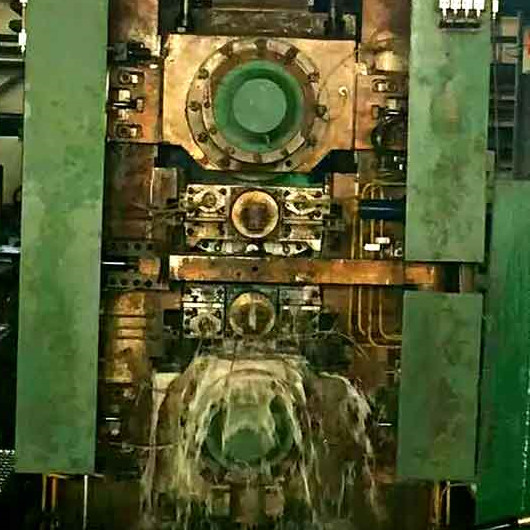
FIG. 1 and FIG. 2 respectively show the mechanical structure diagram of 6-h and 18-h rolling mills. Firstly, from the form of the arch of the rolling mill, the arch structure of the two kinds of rolling mill is almost exactly the same, and there is no obvious difference Again, the key difference between the two is the layout of transverse roll system. Compared with the 6-h mill, the 18-h mill arranges 4 sets of lateral support rolls around the upper and lower work rolls. The diameter of the work roll of the 18-h mill is much smaller than that of the 6-h mill In order to reduce the diameter of the work roll and meet the double needs of stable rolling, the bearing seat of the work roll is cancelled in the 18-h mill, and the lateral support roll system and the thrust device are added, so as to obtain the stability of the roll system under rolling condition The mechanical structure and function of the back-up roll balancing device and the middle roll bending device are basically the same. In the form of the structure of the intermediate roll channeling device, the 6-roll mill adopts the beam structure of channeling the intermediate roll channeling, and the 18-roll mill adopts the structure of channeling the roller bearing seat for channeling the roll; There are differences in the work roll bending. The 6-h rolling mill has the work roll bending device, while the 18-h rolling mill does not. From the perspective of transmission mode, the 6-h rolling mill is mostly the work roll driving and part is the intermediate roll driving, while the 18-h rolling mill is the intermediate roll driving

FIG 1 6 High Mill Stand
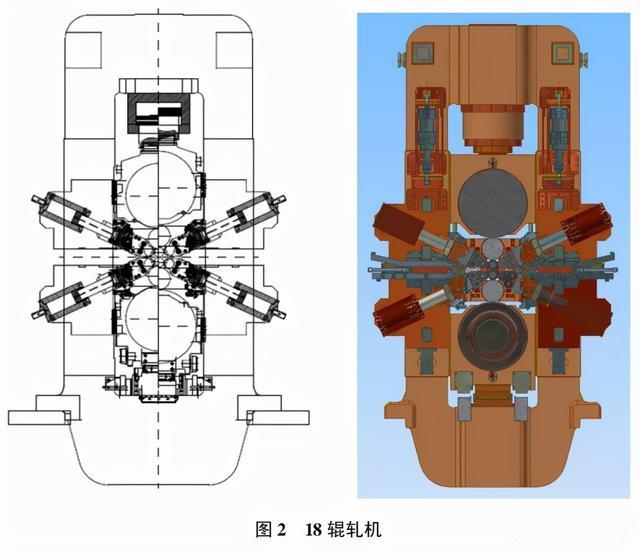
FIG 2 18 High Mill Stand
Table 1 Roll diameter comparison between 6 High and 18 High mill
|
No. |
Name |
6 High |
18 High |
|
1 |
Work roll/mm |
Φ290-450 |
Φ120-170 |
|
2 |
Intermediate roll/mm |
Φ400-490 |
Φ315-380 |
|
3 |
Backup roll/mm |
Φ1100-1300 |
Φ1100-1300 |
2.2 Comparison of operation and maintenance
The relevant operation and maintenance of 6-h rolling mill and 18-h rolling mill in normal production are described as follows. First, roll change time and roll change cycle are important factors related to the smoothness, continuity and efficiency of rolling mill production. Especially for tandem rolling mill, the shorter the roll change time is required, the better, which is related to the length of looper and productivity play For reversible rolling mill with single arrangement, especially for products with high requirements on strip surface roughness, it is required to change the roll in each pass of the finished roll, and it is required that the working roll change time should be as fast as possible. Table 2 shows the general roll change time and roll change cycle of 6-roll rolling mill and Table 3 shows the general roll change time and roll change cycle of 18-roll rolling mill
Table 2 Roll changing time and period for 6 High mill
|
No. |
Name |
Changing period |
Changing time |
Remark |
|
1 |
Work roll |
9-10 coils |
≤5 min |
|
|
2 |
Intermediate roll |
5 days |
≤7 min |
Including time of work roll changing |
|
3 |
Backup roll |
1~2 months |
≤120 min |
Table 3 Roll changing time and period for 18 High mill
|
No. |
Name |
Changing period |
Changing time |
Remark |
|
1 |
Work roll |
6-8 coils |
≤2.5 min |
|
|
2 |
Intermediate roll |
5 days |
≤6 min |
Including time of work roll changing |
|
3 |
Side support roll |
14 days |
≤25 min |
Including work roll and middle roll |
|
4 |
Backup roll |
1~2 months |
≤120 min |
The above data comes from a domestic production plant, and there will be differences due to the different management systems of different production plants
From the above comparison, it can be seen that the work roll change time of the 6-h mill is longer than that of the 18-h mill, and the roll change time of the middle roll and the support roll is basically the same because the 18-h mill has 4 There is no need for the 6-roll mill to replace the side roll box, but the roll change frequency of the side roll box is not high, about two weeks to check or replace from the above roll change cycle and the time consumed, the two kinds of mills for continuous rolling and single placement are no problem, which has been widely verified in the actual production It should be noted in particular that, for the steel with a single reversible arrangement used for rolling high-quality surface requirements, each roll of the finished product is required to be replaced with a new work roll. From the above data, it can be seen that the work roll changing time of 18-roll rolling mill is shorter, only half of the time of 6-roll rolling mill. In this way, the production efficiency of 18-roll will be higher
In addition, from the perspective of tonnage steel consumption of the work roll, the mass of the work roll of the 6-roll mill is generally much larger than that of the 18-roll mill, and the average calculation of the roll consumption of the 6-roll mill is larger from the two aspects of roll change time and roll consumption. In addition, in terms of the use of lubricating and cooling media, both 6-h mills and 18-h mills can use emulsion for rolling. There is no difference between the two, and there is no need to equip with special fire protection system. In terms of roll grinding and management, 18-h mills are better than 6 Rolling mill is a little more complex, mainly side roll box need to grind and assemble some work
2.3 Application area
At present, 6-h rolling mill is widely used in cold rolling field of high strength steel, including HSLA 65Mn C20 DP and TRIP, etc. The tensile strength of strip steel is no more than 800 MPa. For advanced high strength steel with rolling tensile strength greater than 800 MPa, the rolling force is too large and the contact stress between rolls is large In recent years, 18-h rolling mill has been gradually applied in the field of high-strength steel rolling. The 18-h reversible rolling mill of Baosteel has been put into production, and the 18-h rolling mill of Shougang Jingtang is under construction. The main rolling products can cover 6 Rolling mill can roll all kinds of steel, and can roll advanced high-strength steel, such as 780DP/TRIP,980DP and other high-strength steel with tensile strength greater than 800 MPa, or even more than 1000 MPa. In addition, from the perspective of rolling thin strip steel,6 No matter the rolling mill adopts single reversible arrangement or tandem continuous rolling arrangement, the rolling of thin specification products is limited due to the larger diameter of the work roll, while the 18-h mill can roll thinner specification strips due to the smaller diameter of the work roll. The 18-h mill has obvious advantages in thin specification strip rolling, as shown in Figure 3 The relationship between strip width and rolling thickness of a roller mill
3 Conclusion
It can be seen from the above analysis and discussion that there are many similarities between 6-h and 18-h rolling mills in terms of structural form and roll system layout, but there are also obvious differences between the two. The core difference lies in that 18-h rolling mills have transverse support roll system, which makes 18-h rolling mills have good transverse stiffness under the condition of smaller work roll diameter. Thus the stability of the rolling system can be obtained. The small work roll diameter also gives the 18-h mill a strong ability to press down.
In terms of the convenience of operation and maintenance, 6-h and 18-h mills also have a lot of similarities. Both of them can be used well in single reversible or tandem continuous rolling. However, for high-strength strip steel with high surface quality requirements, the required roll change frequency is very high, especially for single reversible rolling, which requires each roll to be changed in the finished pass. In this case, the 18-high mill has higher production efficiency and is more economical in terms of work roll consumption.
In terms of application scope, 6-high mill is suitable for rolling ordinary strength grade high strength steel, but it has limitations and inapplicability when rolling higher strength grade advanced high strength steel and thin specification products.
 Global Steel Demand Stabilizes in 2026: What Opportunities Lie Ahead for Used Steel Equipment?
 Leveler and Cut-to-Length Lines Move Toward Higher Precision as High-Strength Steel Processing Drives Upgrades
 Cold Mill Rolls: Technology Upgrades Support Higher Precision and Rolling Performance
 Domestic Hot-Rolled Coil Transactions Maintain Year-on-Year Growth, Showing Resilient Market Demand
 Green Steel Transition Accelerates the Construction of Next-Generation Pickling Lines
 Global Steel Producers Continue Investing in New Cold Rolling Mills
 Global Steel Producers Continue Expanding Cold Rolling Capacity
 Global Skin Pass Mill Market Reaches $513 Million in 2025, Projected to Exceed $623 Million by 2032
 The Critical Role of Skin Pass Mills in Cold Rolled Strip Production
 How Roll Configuration Affects Product Quality in Hot Rolling Mills
 July 2023 chinese steel products import and export express
 2023 China Chinese Iron and steel industrial reform in 2023
 China national steel production in May 2023
 GLIMPSE 4 HIGH COLD ROLLING MILL DATA SHEET
 GLIMPSE HC 6 HIGH COLD ROLLING MILL DATA SHEET
 The classification of roll materials
 Requirements of cold rolling flat products
 GLIMPSE awarded as a high-quality Chinese supplier of high-quality rolling mill
 The principle and advantages of CVC rolling mill
 What is cold rolling mill?