
Introduction of MKW 8 Hi cold rolling mill
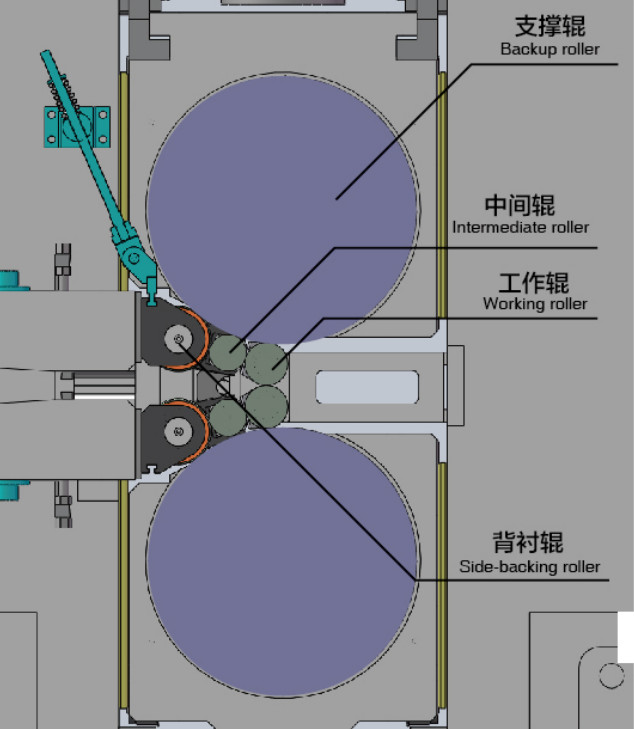
MKW 8 Hi cold rolling mill for stainless steel
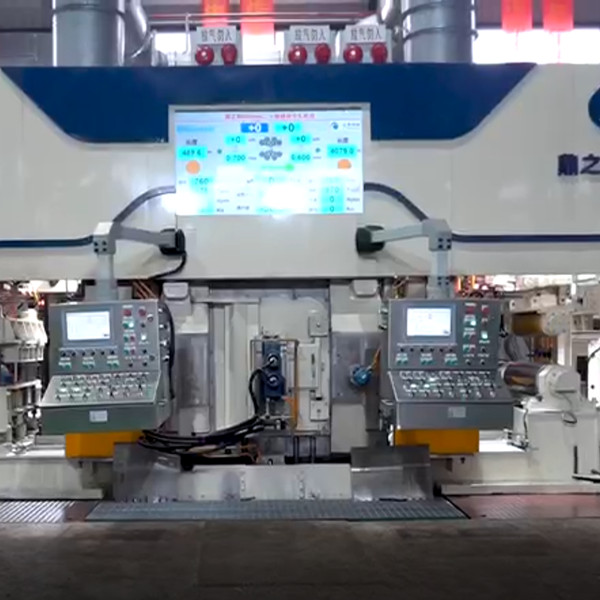
MKW 8 Hi cold rolling mill (also called partial eight-roll mill) is a kind of cold rolling mill with small diameter work rolls and unique structure. It is a kind of cold rolling mill with small diameter work rolls and unique structure. It is a multi-roll mill with side support rolls added to work rolls on the basis of four-roll mill driven by backup rolls.
From the perspective of the structure of the frame, the partial eight-roll mill and the four-roll mill are basically the same, but because the mill uses a small-diameter work roll and a roll profile adjustment device, the position of the work roll is relatively stable, and the horizontal stiffness is high, the overall stiffness is larger than the four-roll mill, and it can roll some products of the 20-roll mill. Because its structure can be changed to two rolls, four rolls, eight rolls and sixteen rolls (double eight rolls) in several forms to meet the needs of multiple varieties, it is also called multi-purpose rolling mill.
1. Structural features
Partial eight roll mill is the support roll drive, the work roll deviates from the center line of the support roll installation, so that the reduction of the diameter of the work roll is neither limited by torque, nor affected by horizontal bending, the diameter of the work roll can be very small, generally only about half of the diameter of the work roll of the same type of four-roll mill, only 15% to 20% of the diameter of the support roll, and the rolling force is only half of the four-roll mill. In this way, the partial eight-high mill can meet the requirements of rolling thin strips and hard to deform metal products like the multi-roll mill, and its structure is relatively simple, similar to the ordinary four-high mill, the complete work roll, the intermediate roll and the side support roll are installed on the supporting arm rotating around the axis of the side support roll, and the side support roll is next to the large support roll. This does not consume the friction contact with the back-up roll and supplies the torque of the work roll, which has a favorable effect on the work roll. During rolling, the vertical force borne by the large diameter back-up roll is transmitted to the frame through the screw, and the lateral force borne by the side support is also transmitted to the frame through the side beam. The contact between the side back-up roll and the back-up roll is maintained by a spring, and the side back-up roll is covered with a roller bearing on the mantel. Equipment investment and maintenance costs are much lower than multi-roll mills.
Like the multi-roll mill, the partial eight-roll mill has more rigid roll system structure and roll profile adjustment device, the total spring value of the mill is small, and the work roll shape can be adjusted at any time during the rolling process, so that the strip steel with small thickness deviation and good shape can be rolled.
The mill support rolls are driven separately, which allows the use of work rolls with a wide range of roll diameter differences. The work roll support is simple and fixed, the roll change is relatively simple and convenient, and the roll loss is small. The friction loss between the rolls is small, and the mill can be lubricated and cooled with emulsion to reduce the friction during rolling.
2. Equipment characteristics
The working stand of partial eight high mill is mainly composed of roll system, press mechanism, work roll neck holding device, swing door and roll profile adjustment installation.
Compared with the four-high mill equipment, the eight-high mill equipment has the following characteristics:
(1) The unique structure of partial eight-high rolling mill
The unique structure of the partial eight-high mill is that the work roll has a side support system and the installation position is deviated from the center line of the back-up roll, as shown in Figure 1. During rolling, the work roll is supported by the upper and lower support rolls in the vertical direction, and the side support system in the side. The side support roll and the middle roll are assembled with a fixed bow and then fixed to the side support roll bearing seat. The lateral force acting on the side back-up roll is transmitted to the side support beam through the support of its concentric axis, so that the axis of the work roll, the intermediate roll and the side back-up roll should ensure that the rolling mill roll system has sufficient stiffness. When the side support roll and the support roll work in contact state, the torque can also be transferred to the work roll through the middle roll, which can increase the pressure and reduce the sliding between rollers. In addition, the work roll deviation from the center of the support roll and the work roll neck device can ensure that the work roll has a reliable stability in reversible and high-speed rolling.
(2) Partial eight-high mill has roll profile adjustment device
Another feature of the partial eight-high rolling mill is the roller profile adjustment device, as shown in Figure 2, the roller profile adjustment is driven by the hydraulic cylinder 1 through the connecting rod 2 to move the four active chee 3 up and down, because the slope of the active chee is different, the middle two of the slope is 5°, the two sides of the slope is 3°, and there are still flat blocks on both sides. In this way, the different bending deformation of the work roll can be made by the side support roll and the middle roll, thus the plate shape adjustment can be realized in the rolling process.
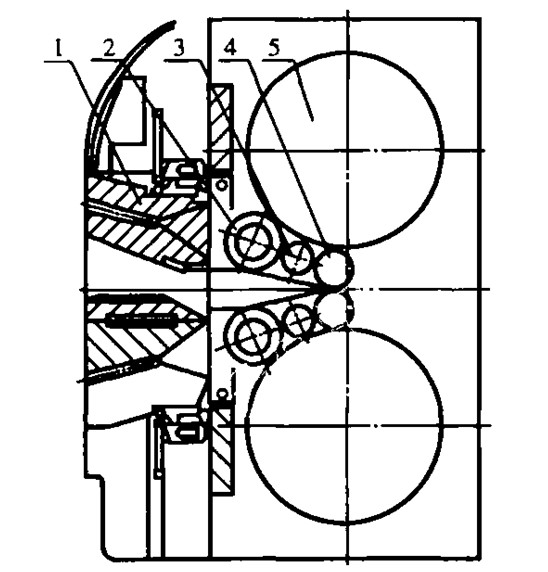
Figure 1
1- Side support beam 2- Side support roller 3- middle roller 4- work roller 5- support roller
(3) The ratio of roll length to roll diameter of partial eight-roll mill
The ratio of roll length to roll diameter of partial eight-high mill is generally 3~10, and the stiffness of lateral support roll system (especially the middle roll) is low. It is easy to slip and chew between the transmission support roll and the work roll; The axis of the work roll, the intermediate roll and the lateral support roll should be ensured in the same straight line, the stability condition is not easy to master, and the roller diameter needs to be matched, which has higher requirements than that of the four-roll mill in manufacturing, installation and adjustment.
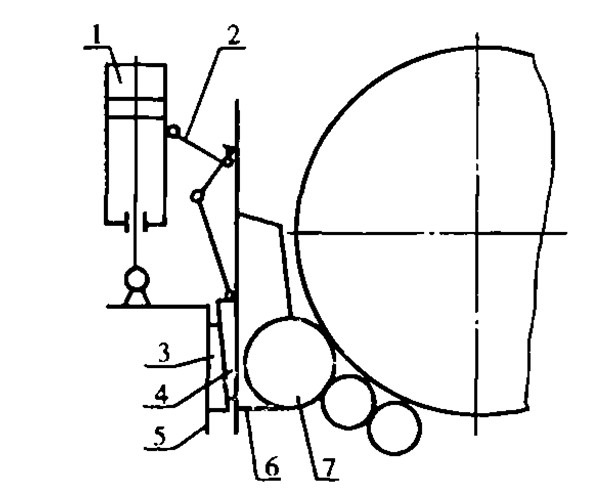
Figure 2
1- Hydraulic cylinder 2- Connecting rod 3- Fixed inclined wedge 4- movable inclined wedge 5- Support 6- side support roller seat 7- Side support roller
3. Process characteristics
The production process of partial eight-high mill is very similar to that of four-high mill, and it has the special point of rolling stainless steel in the specific content. The distribution of the pressure reduction of each pass is also determined according to the principle of equal pressure rolling, and the relative pressure reduction should be reduced by pass. The deformation resistance of stainless steel is large, the work hardening is also large, and the different chemical composition and metallographic structure of the material have different requirements for pressing. Partial eight-spoke rolling process has the following characteristics:
(1) Roll shape control
The roll profile control method of partial eight high mill has not only the original crown of the work roll configuration and the fractional control of the emulsion flow, but also a unique mechanical adjustment device for the roll profile. As mentioned above, the spoke can also be adjusted by a hydraulic cylinder controlled by four diagonal wedges. That is, four bending forces are generated by the action of the inclined wedge on the length of the roll body to cause the work roll to bend, and the amount of deflection can be adjusted according to the rolled strip material and specifications. If the work roller grinding has a crown value of 0.05-0.22mm, when rolling the strip with a width of 1 000 mm, the crown adjustment can reach ± 0.05mm with the increase of rolling force. The adjustment amount is expressed as a percentage on the operating disc, and the maximum adjustment amount is 100%, which is equivalent to an increase of 0.10mm in the working roll crown. Therefore, the partial eight high mill has a better ability of profile control.
(2) Assembly of rolls
The deviation of the work roll from the installation of the back-up roll directly affects the stability of the work roll. The selection of offset should ensure that the work roll is always close to one side during forward and reverse rolling and under the condition of maximum tension difference between front and back. Therefore, when assembling rolls, according to the diameter of the ground back-up roll, side back-up roll and the middle roll, the work roll with the right diameter and the right offset are selected. According to the force analysis of the roll system of the partial eight-high mill (see Figure 3), it can be seen that the work roll offset causes the rolling force to produce a lateral component, so that the work roll is close to the side support roll. The friction drive of the back-up roll produces tangential force on the work roll, which causes the work roll to leave the roll gap and lose the stability condition in the forward rolling. In this way, the force of the side support roll on the work roll is smaller in forward rolling than in reverse rolling. Therefore, the offset of the work roll should be determined according to the condition that the support force of the side support root acting on the work spoke is greater than zero in forward rolling.
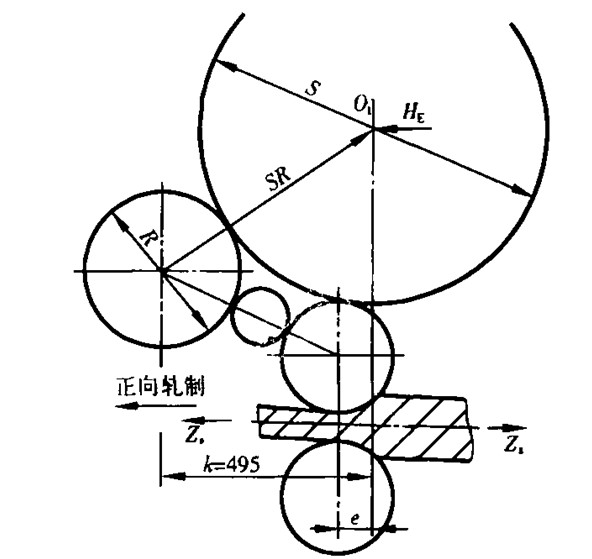
Figure 3 Partial eight-high mill force diagram
4. Conclusion
With the development and progress of modern steel rolling equipment, especially the progress of modern control plate thickness and shape means, the use of partial eight-high rolling mill is limited, and partial eight-high rolling mill must overcome its shortcomings in control plate shape and other aspects in order to meet the market demand and get widely used.
 Why choose AC motor for cold rolling? (I) Disadvantages of DC Motor
 Steel strip rolling process – roll separating force
 Cold rolling mill maintenance and safety technology
 What is the training program about under a sales contract of 20 high cold rolling mill?
 Which is better? Soluble or mineral oil?
 Q8 Roll hardness check
 Q 7 How to properly do roll grinding check?
 Viscosity Classification Equivalents
 Q6: How to do roll storage inspection
 Q 5: What is roll service cycle?
 Q 2 What to do during roll incoming inspection?
 Q1 How to select a supplier of mill rolls?
 The training program for operators of cold rolling mills
 The General principle of rolling speed regulation for cold rolling mills
 Why are stainless steels hard to roll?
 How to choose competent operators for cold rolling mills
 A brief introduction of 20 high cold rolling mill
 Pass schedules for reversible cold rolling mills.
 The design of work roll diameter
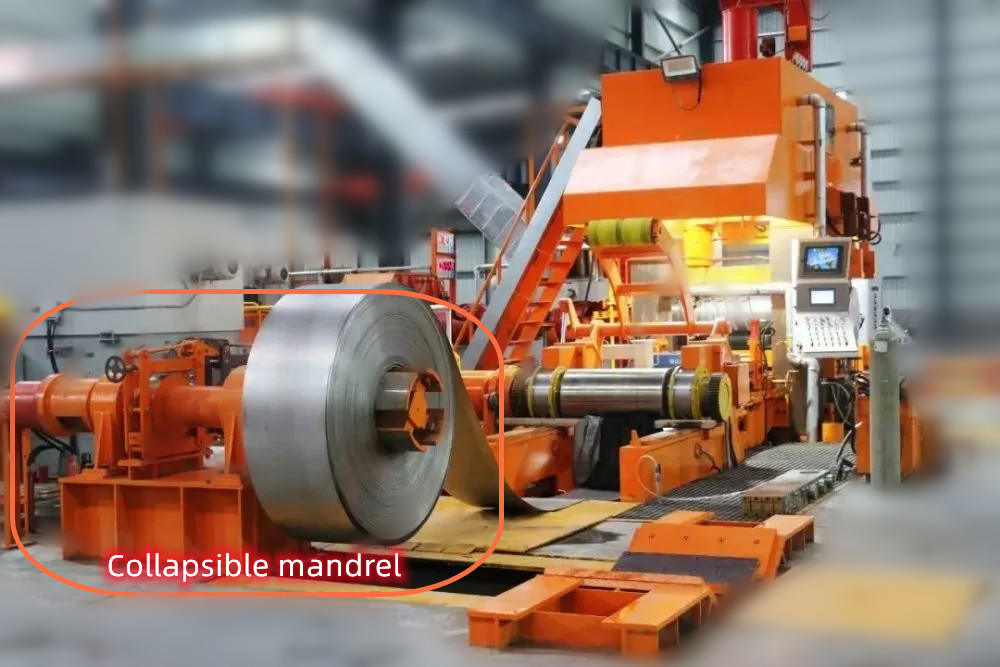 Types of coilers in metal rolling operation