
Pass schedules for reversible cold rolling mills.
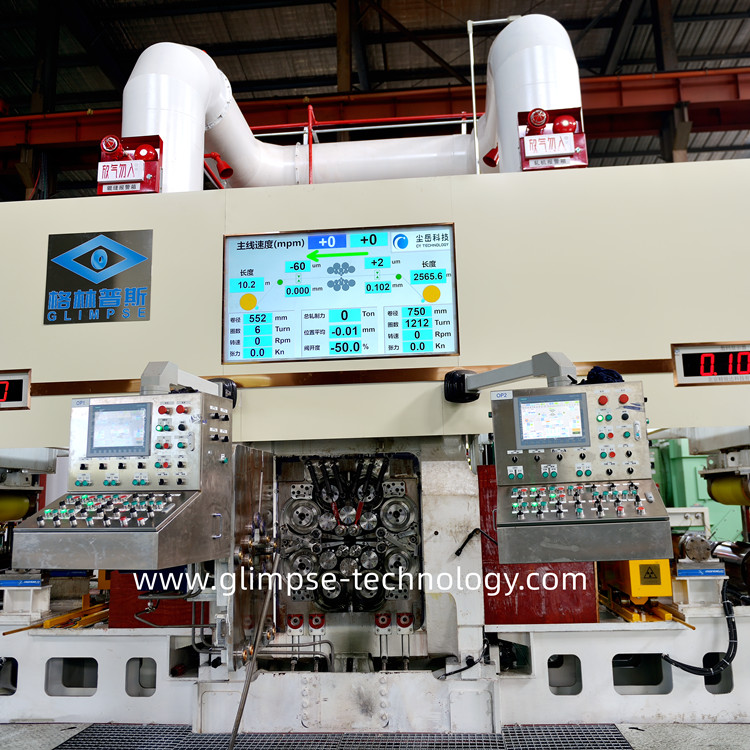
Pass schedules for reversible cold rolling mills.
Many friends consult with glimpse technology about how to make an appropriate pass schedule for a certain job. Most of them operate a reversible cold rolling mill. It is much easier if there are only a few final thicknesses and only one material, like doing jobs in a tandem mill. The reversible mills don’t enjoy this situation, for they have to handle different jobs, so they are also called jobbing mills. They need many pass schedules because the jobs include many different final thicknesses, different grades of materials, and so on.
Some friends are confused that why is it impossible to have a universal pass schedule for all jobs. This article is written for those friends to have good understanding of pass schedule and some common senses about it. It is a very fundamental topic for roller beginner. If you have interest in diving deeply into this topic, please feel free to contact me at gavin@glimpsetech.cn. I am very glad to expect your contact. We have experts in our disposal having various roller experiences in different materials. We love to share with friends. We can give you many references of good practices.
We must have in our mind that it is impossible to give pass schedules for every case. Each rolling mill has its own conditions: the specifications of the rolled materials (such as composition, suppliers and thickness), the rolling itself(including rolls, grinding, power, tension, etc.), the customers who always have their different equipment concerning thickness, finish, properties, and the ancillary operations such as annealing and pickling processes.
However, we can have indicative values and a method for making better pass schedules. Please keep in mind the following two useful recognitions:
1) A schedule may be considered appropriate only after several decisive experiments have completed.
2) The pass schedules must never be considered definitive. As times goes by, conditions change, including the operators’ skill, the preparation of the strip and the rolls, the characteristics of the incoming material and so on. All these conditions have to be taken in to consideration.
Below are the useful takeaways we achieved from our project experiences with the kindness of our clients.
1) The thickness of hot-rolled coils is often higher than the nominal thickness. Pass schedules should be calculated according to real thicknesses.
2) Some materials are much more expensive than others. For example, stainless steels having a high percentage of nickel and chromium generally carry a high price tag. Some materials can be expensive in other ways, such as those which require a long delivery time from hot rolling, as is the case with very special grades of steel, for example. For these materials, it is preferable to avoid excessive risk and to strive for the production of quality over volume.
3) There is usually a core product.
Generally, if the monthly program is scrutinized, you will find that certain pass schedules represent the bulk of the mill's production load, regardless of the diversity of the incoming material. Therefore, the most appropriate goal is to improve production of the most frequently rolled materials.
4) Optimization
• Rolling conditions are not optimal during commissioning. The operator is still being trained, for example. In addition, if other equipment is also new, the difficulties are compounded. Annealing, pickling, and roll grinding may still not be efficient, for example. So, the first pass schedules have to be progressively improved.
The pass schedules should be periodically reconsidered, not only during the first year but throughout the life of the mill. The materials, the rolling oil, the extent to which the rolls have been ground — this all changes over time.
• The greater the number of pass schedules, the most useful the comparison between them, for this is where anomalies appear. Usually, several types of materials have to be rolled using the same roll profiles (crowned, tapered rolls). A good example is stainless steels, austenitic grades (series 300) and ferritic grades (series 400): the roll profiles have to be a suitable compromise.
5) The pass schedules should be different for materials having different mechanical properties. If, for the same initial and final thicknesses, the same pass schedule is used for different materials, it will be automatically adapted to the hardest material. Consequently, the number of passes will be excessive for the softer materials, and it will be difficult to use the same roll shape.
However, in the case of numerous grades, the materials can be grouped in families. For example, for stainless steels (series 300), the families can be:
• soft (low carbon, C < 0.025%),
• hard (medium carbon, C < 0.06%),
• very hard (high carbon, C > 0.06%).
6) Strip width has to be taken into consideration.
If, for example, widths of 1200 mm and 1500 mm are rolled on the same mill, the pass schedules may have to be different even though the material and the initial and final thicknesses are the same. This is particularly true in the case of thick material.
The main reason is tension. For example, 50 tons represents a specific tension of 8.3 kg/mm2 for 4 mm • 1500 mm, and 10.4 kg/mm2 for 4 mm •1200 mm. So, the skidding is pushed back for narrow strip, while the Roll Separating Force (R.S.F.) and the mill stand power are reduced.
7) The best pass schedules
Searching for the best pass schedules can (and should) lead to modification of the initial thicknesses (given by hot rolling) and of the intermediate thicknesses (for thin products needing intermediate annealing).
For example, if the number of passes is the same whether the initial thickness is 2.3 or 2.5 mm, it is better to choose 2.5 mm, for the hot rolled product is cheaper.
When producing many final thicknesses, it is better to limit the number of initial thicknesses so as to facilitate the bulk order of stock and reduce inventory. Knowing which initial thicknesses to choose depends on the pass schedules. For example: choose for final thicknesses of
5 mm 1.5 – 2.5 mm
4 mm 0.9 – 1.49 mm
3 mm 0.4 – 0.89 mm
If a final thickness of 0.4 mm represents an important part of the program, an initial thickness of 2.5 mm can be used. The intermediate thicknesses have to be optimized according to the pass schedules for the first and second rollings. If, due to quality requirements, a final thickness of 0.4 mm has to be produced in two stages, starting from 4 mm, a wrong intermediate thickness for annealing can lead to one more pass, as can be seen in the following example:
If, for the first stage, 1.4 mm can just be reached in six passes, and seven passes are necessary for the second stage (from 1.4 mm to 0.4 mm), then the total is thirteen passes.
However, if 1.5, instead of 1.4, is chosen as the intermediate thickness, the first stage will still need six passes, but eight passes will probably be necessary to get from 1.5 to 0.4 mm. The total will be fourteen passes instead of thirteen.
8) The number of passes, even or uneven, is very important. With an uneven number of passes, the strip finishes at the opposite side of the payoff reel. So, extraction of the finished strip and threading of the next strip can be performed simultaneously. In addition, the end of the finished strip can be used to help thread the next strip (see chapter 15 about strip threading).
This is the end of this article. If you have any idea about this topic, please feel free to contact me. Thank you. You can get a free consultation with our experts about forming your own pass schedules for 20 high, 18 high, 6 high, 4 high mills and carbon steel, silicon steel and stainless steel, etc.
Next time, we will cover this topic again with example pass schedules for different materials concerning reduction, speed and tension for various types of mills. If you are interested in this tope, please give me your email address, so that I can send you the update timely.
 Why choose AC motor for cold rolling? (I) Disadvantages of DC Motor
 Steel strip rolling process – roll separating force
 Cold rolling mill maintenance and safety technology
 What is the training program about under a sales contract of 20 high cold rolling mill?
 Which is better? Soluble or mineral oil?
 Q8 Roll hardness check
 Q 7 How to properly do roll grinding check?
 Viscosity Classification Equivalents
 Q6: How to do roll storage inspection
 Q 5: What is roll service cycle?
 Q 2 What to do during roll incoming inspection?
 Q1 How to select a supplier of mill rolls?
 The training program for operators of cold rolling mills
 The General principle of rolling speed regulation for cold rolling mills
 Why are stainless steels hard to roll?
 How to choose competent operators for cold rolling mills
 A brief introduction of 20 high cold rolling mill
 The design of work roll diameter
 Types of coilers in metal rolling operation
 Introduction of MKW 8 Hi cold rolling mill